
For 75 years, Paralyzed Veterans of America has been on a mission to change lives and build brighter futures for our seriously injured heroes—to empower these brave men and women with what they need to achieve the things they fought for: freedom and independence.
Washington Update
Check out the PVAction Force page to view alerts and a list of key legislation.
Major Victory!
Congress Passes Elizabeth Dole Legislation
On December 16, Congress finally passed the Senator Elizabeth Dole 21st Century Veterans Healthcare and Benefits Improvement Act (H.R. 8371/ANS to S. 141). This legislation addressed some of the biggest legislative priorities for PVA, like eliminating the cap on the amount VA can pay for care in the home; increasing access to home and community-based services, like Veteran Directed Care; and strengthening supports for caregivers.
Other PVA-endorsed provisions in the bill allow veterans’ survivors to retain their eligibility for education benefits and create a pilot program for the VA to furnish assisted living services for certain veterans in rural areas. Barring anything unforeseen, the package should be on the President’s desk before the year is over. PVA has worked tirelessly over the past few years to get these critical, life-changing provisions signed into law. We look forward to working with the Administration on implementation.
Another Major Victory!
DOT Releases Proposed Rule to Improve the Air Travel Experience of Wheelchair Users
On December 16, the Department of Transportation (DOT) released a final rule on ensuring safe accommodations for wheelchair users in air travel. The final rule resulted, in part, from PVA’s February 2022 DOT petition to initiate rulemaking, as well as follow up letters on the topic. The new requirements, many of which go into effect in January, will dramatically improve the air travel experience for people with disabilities. Specifically, they clarify airlines’ obligations and responsibilities to individuals with disabilities; better enforce violations and administrative penalties onto airlines that mishandle assistive devices; and improve airline processes for returning, repairing, and replacing mishandled wheelchairs, to include informing wheelchair users about the location of their device during transit and allowing them to choose their own repair company, if their wheelchair or scooter is damaged. The changes also mandate critical hands-on training on an annual basis to any airline staff or contractors who physically assist passengers with mobility disabilities or handle battery-powered assistive devices.
PVA’s comments on DOT’s proposed rule were extensively referenced in the discussion language accompanying the final regulation. These changes represent the culmination of a multi-year effort spearheaded by PVA to improve the safety and dignity of wheelchair users in air travel. Thank you to everyone who shared their air travel stories, filed complaints, and commented on the proposed rule. Click here to watch DOT’s event announcing the final regulation.
Update on VA Funding Shortfall/FY 2025 Funding
At the end of November, the VA announced that it needed an additional $6.6 billion to fill gaps in the Veterans Health Administration budget for fiscal year (FY) 2025. In addition to needing funds to hire clinicians and purchase much-needed equipment, VHA stated a need for relief due to the cost pressures occurring in the pharmacy and prosthetics programs that were not anticipated when the VA developed its FY 2025 budget.
On December 17, Congress unveiled a short-term bill to keep the government funded through March 14, 2025. The bill contains language codifying VA’s Veteran Experience Office and providing greater oversight of the department’s accounting procedures. The latter provision would require VA leaders to regularly meet with the members of the VA committees for the next three years to provide updates on the agency’s finances. It also would withhold bonuses to senior VA leaders when financial shortfalls exist.
Although the VA requested to receive the needed $6.6 billion in additional funding in the continuing resolution, it was not included in the released bill. It’s unclear whether or not the request will be revised in the new year. Recent hearings on VA’s reported shortfall showed that many members of Congress were unhappy with VA’s management of its budget and inability to accurately project its financial requirements.
House VA Subcommittee Takes Last Look at
Pending Bills
PVA submitted a statement for the record for a December 17 House Veterans’ Affairs, Health Subcommittee hearing where lawmakers examined 10 pieces of veterans-related legislation. In our statement, we supported bills that would allow veterans to receive eyeglass lens fittings through a VA community care provider; clarify the reimbursement process for emergency treatment furnished in non-VA facilities; and direct the Government Accountability Office to conduct a study on menopause care furnished by the VA.
One of PVA’s top priorities is to ensure proper staffing in VA’s health care system. Without proper staffing, veterans may be forced to accept care in the community, even when it is not their choice to do so. Thus, PVA endorsed new legislation that would allow VA to pay for the medical education of an officer of the commissioned corps of the Public Health Service in return for an obligated period of service at a VA health care facility. We believe this legislation would help fill some of VA’s most critical staffing needs while attracting more health care providers to the department. We also supported many of the provisions of H.R. 10,267, the Complete the Mission Act of 2024, which seeks to preserve access to community care and strengthen requirements from the VA MISSION Act of 2018 (P.L. 115-182). PVA supported or had no objections to many of H.R. 10,267’s provisions, including requiring the department to notify veterans of their eligibility for community care and if their requests for such care are denied. We continue, however, to have significant reservations with proposals to apply value-based reimbursement models to VA care, regardless of where it is delivered. In value-based care, health care providers are reimbursed based on the quality of care they provide, rather than the number of services they perform. Complex health issues like SCI/D do not fit neatly into such models and could have unintended consequences for veterans with these conditions. We are unable to support such requirements until there is straightforward evidence that the care veterans with SCI/D might receive, and/or their access to it, would not be impaired through the use of such models.
PVA did not endorse a trio of bills that sought to widen the aperture of eligibility for community care by diverting VA funding into other healthcare programs, including a pair of newly created pilot programs. We have grave concerns about the impact this legislation would have on catastrophically disabled veterans; therefore, we cannot support them at this time. A recording of the hearing and all relevant documents, including PVA’s statement, can be found here.
PVA Testifies at Oversight Hearing on VR&E
On December 11, PVA participated in an oversight hearing on the Veteran Readiness and Employment (VR&E) program held by the House Veterans’ Affairs Committee, Subcommittee on Economic Opportunity. Associate Legislative Director, Julie Howell, testified on behalf of PVA and was joined by the President of the National Association of Veteran Program Administrators (NAVPA).
The first panel was the Director of the VR&E Program, Nick Pamprin, and he was joined by Kenneth Smith, the Assistant Deputy Undersecretary for the Operation Management Team at the Veterans Benefits Administration. The subcommittee reprimanded the VA for not doing more to ensure that veterans have timely access to the VR&E program and they shared concerns about IT modernization efforts that are underway. The VA shared that in the past two years the program has seen record growth with very few additional supports for counselors working in the field.
PVA focused its statement on solutions that Congress could pass to address systemic issues in the program. Our testimony suggested that Congress remove the 12-year delimiting date that creates a barrier for veterans accessing the program if they’ve been separated from service for 12 years or more. PVA also stressed the need for increasing the number of VR&E counselors in the field to help with wait times in the face of high enrollment and application numbers, reducing the minimum education requirements for veteran success on campus counselors, and tying the subsistence rate for VR&E to that of veterans using the Post 9/11 GI Bill.
House Passes VETS Safe Travel Act
On December 10, the House passed an amended version of the VETS Safe Travel Act (H.R. 7365). This bipartisan legislation, introduced by Rep. Paul Gosar (R-AZ), would provide free access to TSA Pre✓® for certain eligible veterans who otherwise meet the requirements of the program. Unfortunately, the bill was amended prior to passage to limit eligibility to veterans with service-connected disabilities. On December 11, Senator Todd Young (R-IN) and a bipartisan group of Senators introduced a companion bill (S. 5487). It’s uncertain whether the House version of the bill will be addressed by the Senate prior to the end of the congressional session.
Tech Mod Subcommittee Holds Oversight Hearing on Modernizing VA’s IT Systems
On December 12, the Technology Modernization (Tech Mod) Subcommittee for the House Veterans’ Affairs Committee held an oversight hearing reviewing the work of the subcommittee over the 118th Congress. The hearing focused on addressing the challenges with VA IT projects like Electronic Health Record Modernization, Financial Management Business Transformation, and the Digital G.I. Bill rollout. Representatives from the VA, Government Accountability Office, Georgetown University, and the Foundation for American Innovation were present and provided in-person testimony.
While the consensus was that modernizing VA’s IT systems would have undeniable benefits, it must be done with proper oversight and management. The hearing highlighted many recent projects whose cost had gone far beyond their original budgets. Notably, this was the final hearing for outgoing Chairman Matt Rosendale (R-MT) who was the Chairman of the Subcommittee in the 118th Congress and the Ranking Member in the 117th. You can watch the hearing here.
News of Note
Major VA Construction Bill Approved
PVA works to protect VA’s specialized care services by trying to ensure funding is provided for the department’s infrastructure projects. Recently, Congress approved S. 4176, the Fiscal Year 2024 Veterans Affairs Major Medical Facility Authorization Act, which authorized the use of previously approved funding for 11 major construction projects around the country. One of these projects included nearly $312 million toward the construction of a spinal cord injuries and disorders (SCI/D) center, renovation of parking facilities, and upgrades to the central utility plant at the San Diego Health Care System. A portion of the funding will also go towards a seismic retrofit of San Diego’s existing SCI/D center.
Legislation Requiring Amtrak Reports on Station Accessibility Headed to the President
On December 17, the House passed the bipartisan Think Differently Transportation Act (S. 4107). The legislation was introduced in the Senate by Senator Tammy Duckworth (D-IL) and Senator Shelley Moore Capito (R-WV) and in the House (H.R. 6248) by Representative Marc Molinaro (R-NY) and the late Representative Donald Payne, Jr. (D-NJ). This legislation will require Amtrak to complete an action plan and provide status reports on its efforts to comply with the Americans with Disabilities Act at Amtrak-served stations.
Lurie Institute Launches Interactive Dashboard to Spread Education on People with Disabilities
The Lurie Institute for Disability Policy has launched a Disability Data Dashboard. The interactive dashboard serves as a resource for researchers, advocates, and policymakers to learn more about people with disabilities and community living services. The Institute is also looking for feedback on how to improve the dashboard.
IVF in the NDAA
Several times over the past few months, we highlighted that IVF expansion language was in both the House and Senate drafts of the National Defense Authorization Act (NDAA), the funding vehicle for the Department of Defense. While this was the first time both bills contained IVF expansion provisions, the final language of the bill did not include any. However, language creating a pilot program for cryopreservation did make it into the final version of the NDAA, which passed the House on December 11. The Senate passed it on December 18.
Webinars & Committee Activities
Government Relations Webinars on PVA.org
October and November were busy months for PVA’s Government Relations team. On October 29, we covered this year’s efforts to improve access to air travel for people with disabilities in our webinar titled, “Improving Disability Access in Air Travel.” Then, in November, we kicked off caregiver month by discussing the results of a RAND study on caregivers with representatives from the Elizabeth Dole Foundation titled, “Hidden Heroes Emerging from the Shadows.” Finally, we wrapped up November with a webinar with TSA titled, “Navigating Airport Security as a Passenger with a Disability.” Recordings for these webinars are now available on PVA.org.
Access Board Hosts Webinar on Its Role in Accessibility
The U.S. Access Board will host a webinar on January 9, 2025, from 2:30 to 4:00 P.M. ET. During the webinar, members will educate attendees on the Access Board’s role in creating, enforcing, and providing training on accessibility standards. The webinar will also cover how federal agencies lead and enforce accessibility standards in other areas.
Registration for the webinar is now open.
Veterans’ Committee Activities
Please visit the House and Senate Veterans’ Affairs Committee webpages for information on previous and upcoming hearings and markups.

February 3, 2023 by Lisa Elijah
The 118th Congress is officially underway, and the House and Senate have a lot of work to do. The Department of Veterans Affairs (VA) has long been a leader in providing specialized healthcare services and long-term care for veterans with spinal cord injuries and disorders. Paralyzed Veterans of America’s (PVA) 2023 legislative priorities are aimed at not only protecting access to these specialized services, but also increasing access where needed. We also support priorities that will ensure veterans with significant disabilities have equitable access to the same opportunities as other Americans.
We are proud of the progress made in the 117th Congress. Through your support, PVA was able to help pass H.R. 4794/S. 2533 MAMMO Act, which requires the VA to implement and improve breast imaging services for veterans. Additionally, H.R. 7939, the Veterans Auto and Education Improvement Act, became law and allows the VA to provide an additional automobile allowance to certain eligible veterans. The passage of these bills was a step in the right direction for supporting our nation’s veterans and we hope to continue the same momentum through 2023.
Our 2023 policy priorities focus on increasing funding for veteran health care, modernizing VA facilities, and improving access to opportunities and freedoms available to all Americans. These efforts will help protect veterans’ access to the specialized health care services they need, while also expanding their access to VA long-term care, including home and community-based services. Congress must also take a hard look at how it can better protect the civil rights of individuals with disabilities. This includes ensuring an improvement in how air travel is handled for people with disabilities, particularly wheelchair users, by reforming the Air Carrier Access Act to add standards for aircraft accessibility and improving enforcement of the law.
An exhaustive list with more detailed goals is outlined in our 2023 policy priorities. By creating legislation from our 2023 legislative priorities, Congress can ensure that our nation’s veterans receive the support they deserve.
If you are passionate about a specific issue, make sure to reach out to your legislators in PVAction Force through our campaign and add your own story to share how much it means to you. Also, check out the full list of legislation of interest to PVA and our stance on each bill.
PVA is dedicated to improving the lives of veterans with disabilities and their families. We hope to make a lasting impact on the lives of our members. This call to action is an opportunity for us all to help be of service, and it is a chance for us to join together and make sure that our government is doing all it can. We must ensure that our legislators are working toward legislation that will benefit our nation’s veterans, so that they can live their lives with dignity, respect, and independence. Hearing directly from you helps legislators understand what is important to their constituents, and holds an immense amount of power over how they lend their support. Join us to make our goals a reality.
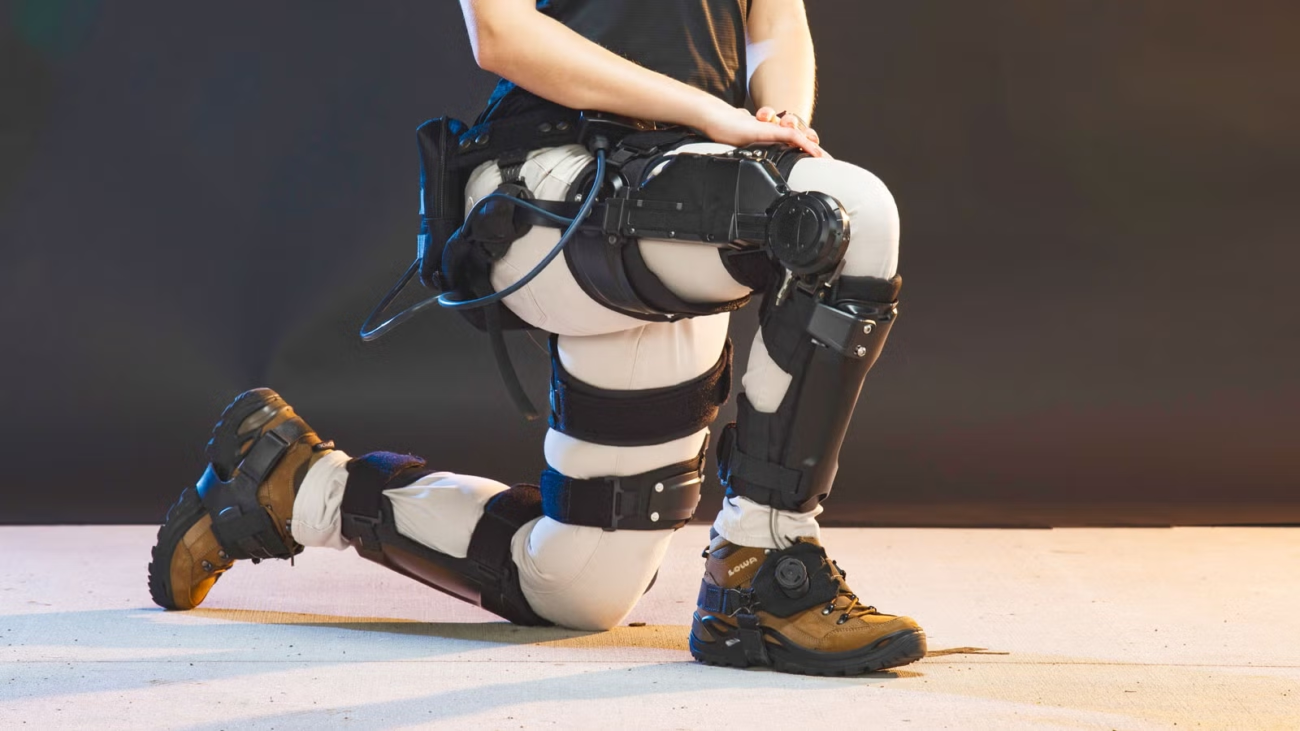
Hello everyone, I am Jose Reynoso your newly appointed Vice President for the Paralyzed Veterans of America California Chapter in Long Beach. In this short article I want to pass information over to you all about the exoskeleton robotic legs. Not only does it sound pretty awesome but for those who qualify it also allows you to do the impossible which is to stand up and walk with this assisted device. There are certain restrictions to be eligible to participate in this device as it is for everything else available for us, I’ll include the personnel contacts in charge of this research program at the end of this article so anyone interested can get a hold of them.
This device, the exoskeletal robotic legs was able to grant me the impossible which I thought would never happen again. That experience was to stand tall and see the world differently again, as my former self did, standing up and walking. It was a little challenging at first getting the rhythm of how to use the device, concentrating on not stalling the machine and having it stop on you mid step but that’s part of the experience trial by error. Being able to stand up to my actual height and seeing how everything looks as it did really feel incredible and not only did it felt incredible but I was also able to stand next to my family and seeing how short they really are.
The exo suit gave me and my family a lot of good memories and beautiful moments that will forever cherish. I was able to walk basically almost anywhere I wanted to go, take a stroll at the park, go to the movies, go out to eat dinner anywhere you’d want to go that the device will allow you to go if the terrain permits. Not only does it consist of you walking again, but it also provides a really good workout as if it’s a gym of its own. You’re constantly having to keep yourself balanced so it makes you exercise not only your body but your mind as well. Having to focus on how you step, and where to step, how to move a certain way, and to turn a certain a certain way. Its incredible what this device allows you to do and that sense of freedom that it brings upon you as if you have lost nothing. I would highly recommend this device to everyone since it keeps you active and brings back a portion, we all have lost and have longed for since day 1 and builds beautiful memories you’ll never forget. I thank you for taking the time in reading this article, and also here is the research team you can get a hold of to get all the information you need and the restrictions for the device and what is required to participate in them.
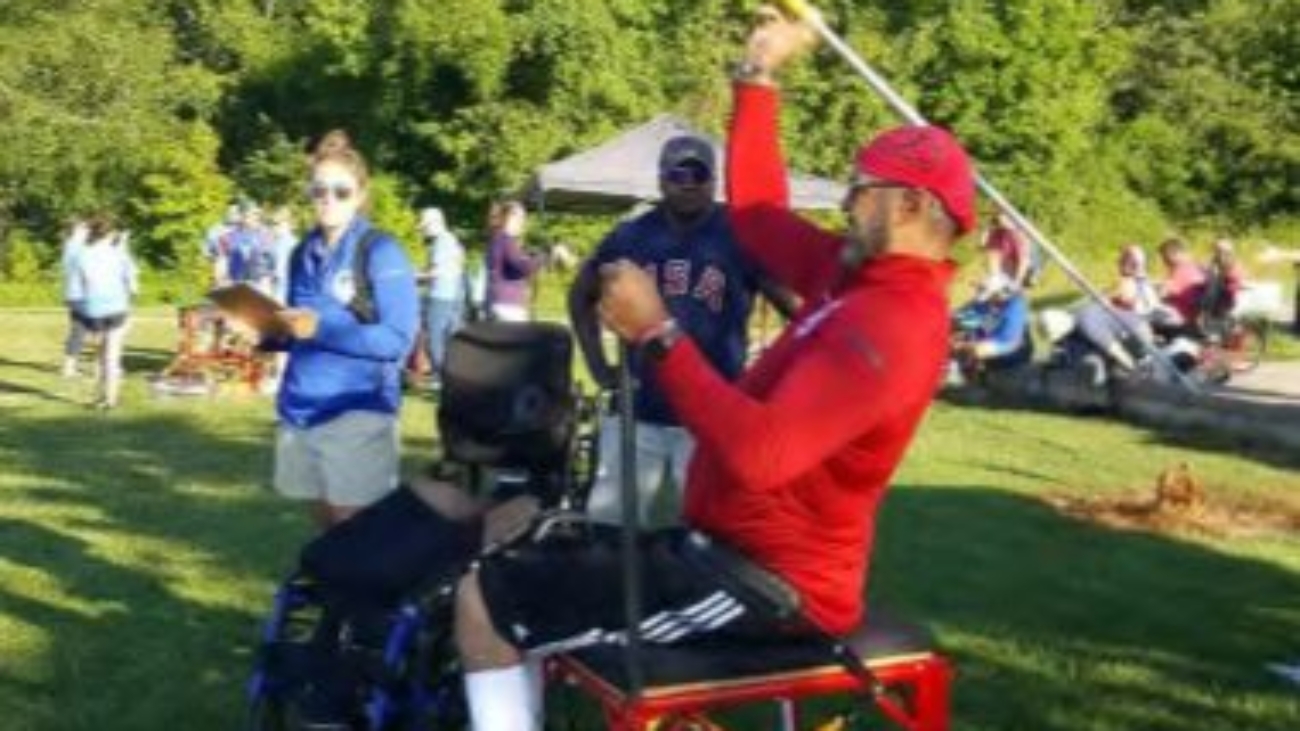
Darryl Lair had a Great Time at the 2019 NVWG’s. Here are his recollections from the experience.
I competed in six games.
1. Wheelchair Basketball – my team name was the Iron Liege “57”, we won two games and played our third for the bronze medal, we were ahead by 8 points to half time. But our shot did not fall in the second half and we lost by 6 points, that was a tough lost. But we had fun.
2. Archery – I played golf that day and we got back a hour late and could not compete.
3. Golf – Had a great time playing golf. We played at Quail Chase Golf Course 3 Person Best Ball Louisville Kentucky Tournament, Mr. Fuzzi Zoeller PGA 1979 Champion was the honorary guest.
4. Air Rifle – the Air Rifle competition was tough, those veterans could shoot accurate.
5. Track & Field Discus – Was Great, I won a Gold Medal, I through the Discus 41′.
6. Track & Field Javelin – Was Fun also, I didn’t through the Javelin very far.
The flight to Louisville Kentucky on American Airlines was pretty good. Overall Louisville Kentucky was a Great Host, we stayed at the Galt Hotel East, Very nice accommodations.
The convention center here most indoor events was only two blocks away and downtown Louisville. The opening ceremony was awesome, there were over sex hundreds wheelchair veterans there ready to compete. Lots of restaurants close by. Got a chance to eat at White Castle Burger and Spaghetti Factory. My wife Rachel who is my personal care assistance (pca) had a great time in Louisville also.
From our hotel room we could see the Belle of Louisville River Boat on the Ohio River. We was a couple blocks from the Muhammad Ali Center and the Louisville Slugger Baseball Bat Company. Really enjoyed ourselves at the 39th NVWG’s. Next year’s 2020 40th NVWG’s will be in Portland, Oregon.
Thank you PVA California Chatper for sponsoring me so as I was able to compete with Team Long Beach in Louisville Kentucky at the national veterans wheelchair games.
I’ve been to many wheelchair games in the past and I think this was the best one.! It was very well organized, Logistics was great, the hotel room was nice, the weather was good , the people were super friendly the food was amazing and most of all… the competition and camaraderie is unparalleled.
I competed in five events. Swimming, softball, 9-ball, table tennis and air pistols. I won a gold medal in the 50m backstroke, a silver medal in softball, a bronze medal in 9-ball and a bronze medal in table tennis. It was a very good week and my consistent efforts in going to the gym and training really seemed to pay off.
I was also able to participate in something new this year. I was chosen as one of the mentors for kids day. I work with children with disabilities here in California pretty frequently and very much enjoy it. Kids day was such an inspiration as these children have big hearts and glowing spirits!
Rebecca and Ina from LBVA RT were there as coaches and helped out when necessary. I saw them frequently throughout the week at my events and other events.
Again, thank you for your sponsorship as this was a fantastic week and very beneficial to people with SCI and other disabling conditions.

